
How to use PAL
PERFUSE Anesthesia Lab (PAL) brings interactive labs, simulators, and patient case material together in one place.
How to use PAL
There are several ways to work through PAL.
Foundational Modules
Foundational Modules cover the essential physiology, one mechanism at a time: the action potential, the cardiac cycle, how the kidney concentrates urine, the clotting cascade. Each one is animated step by step, so you watch the mechanism work instead of reading about it. The set spans the heart, lungs, nerves and muscle, kidneys, blood, acid–base and the stress response, and some labs show where anesthetic drugs act on the system. Use the menu at the top of a Foundational Module to change its view.
Learning Simulations
Every Learning Simulation has four views: Learn, Sandbox, Challenge and Review.
- Learn: guided stages, with the live graphs beside the text.
- Sandbox: the full simulator. Get in and play.
- Challenge mode allows you to validate your understanding through exercises and questions.
- Review: questions with a reason for every answer, and a link back to the stage that teaches it.
OR Day
Practice care planning in simulated medical records. Open one of 81 patients and move through a full mock chart: surgical booking, history, home meds and MAR, labs, real chest films and ECGs, past notes, blood bank, consents and the preop nursing check-in. Clues are spread across the chart the way they are in real life. A relative who was “slow to wake up after anesthesia” in the family history only makes sense next to the nursing notes, and scanned records from past anesthetics show what was done last time.
The G.A.S. (General Anesthesia Simulator) family of simulators
G.A.S. is a full anesthesia simulator. You run the machine, change the ventilator settings, give the drugs and manage the airway. You can speed up time and watch the patient respond on a live monitor: heart rate, blood pressure, oxygen, CO2, temperature and depth of anesthesia.
Simple is the anesthesia machine on its own. Advanced adds a patient and a case, with drugs, surgery, blood loss, airway events, reversal and emergence. Six more labs each take one part of the job: Induction and Airway, Crisis, TIVA and Low-flow, Emergence, Find the Problem and Machine Checkout.
Clinical context cards
Four categories give you a holistic view of the factors that impact your anesthesia.
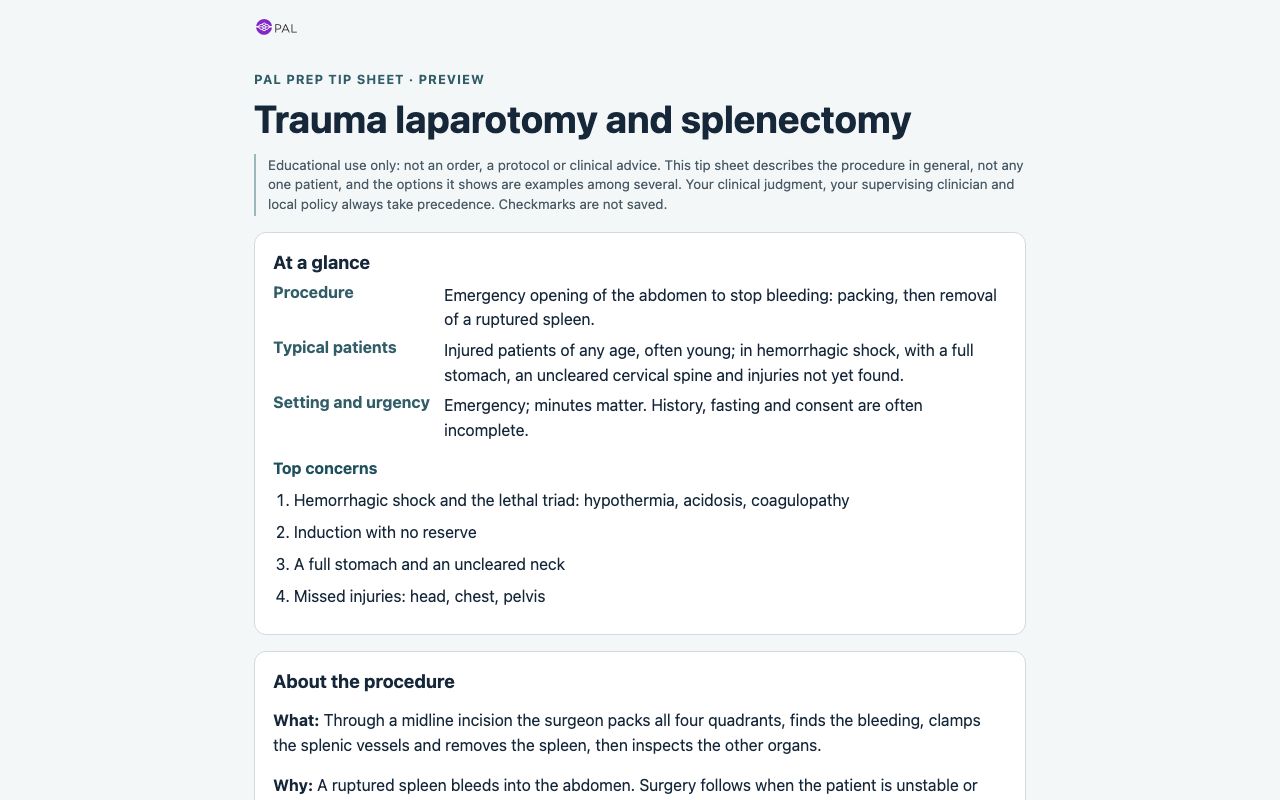
- Case cards. A case card is a prep sheet for one procedure and how it affects your anesthetic plan.
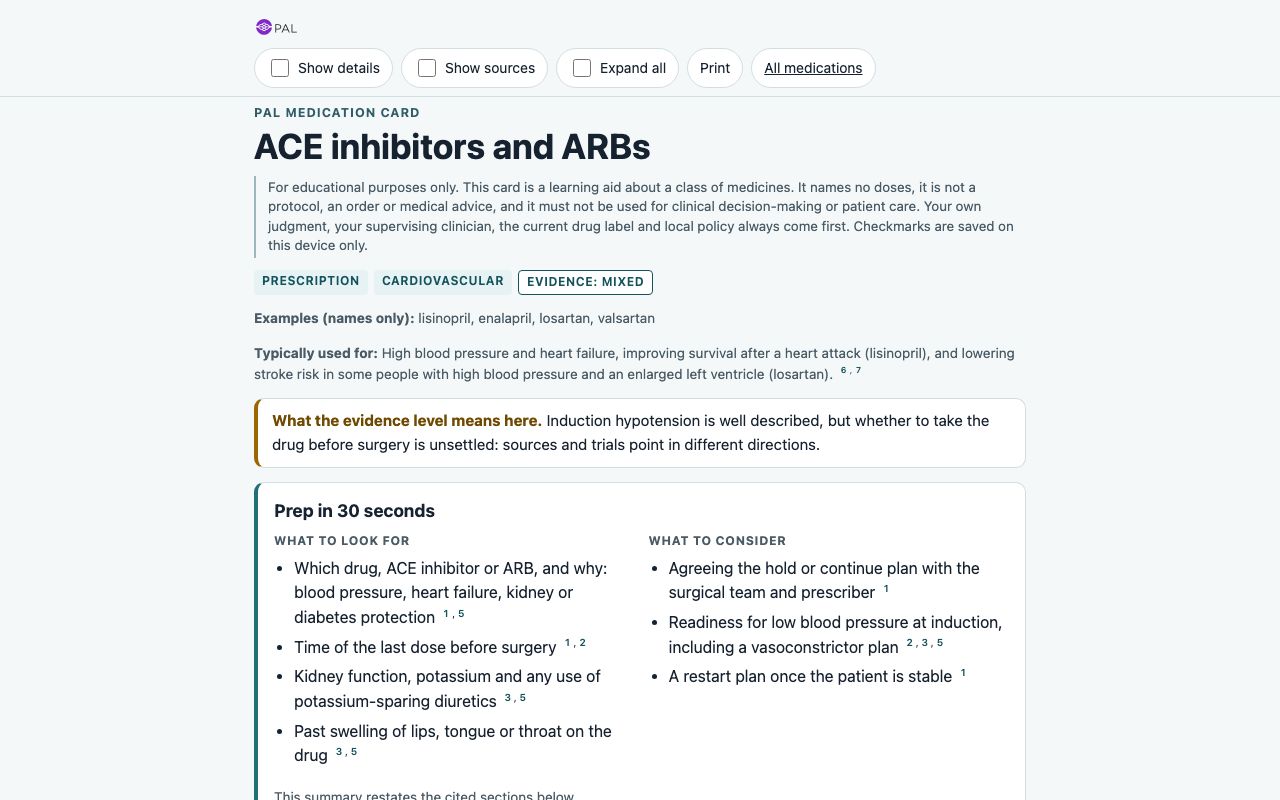
- Medication cards. A medication card covers one medicine a patient takes at home and how it affects your anesthetic plan.
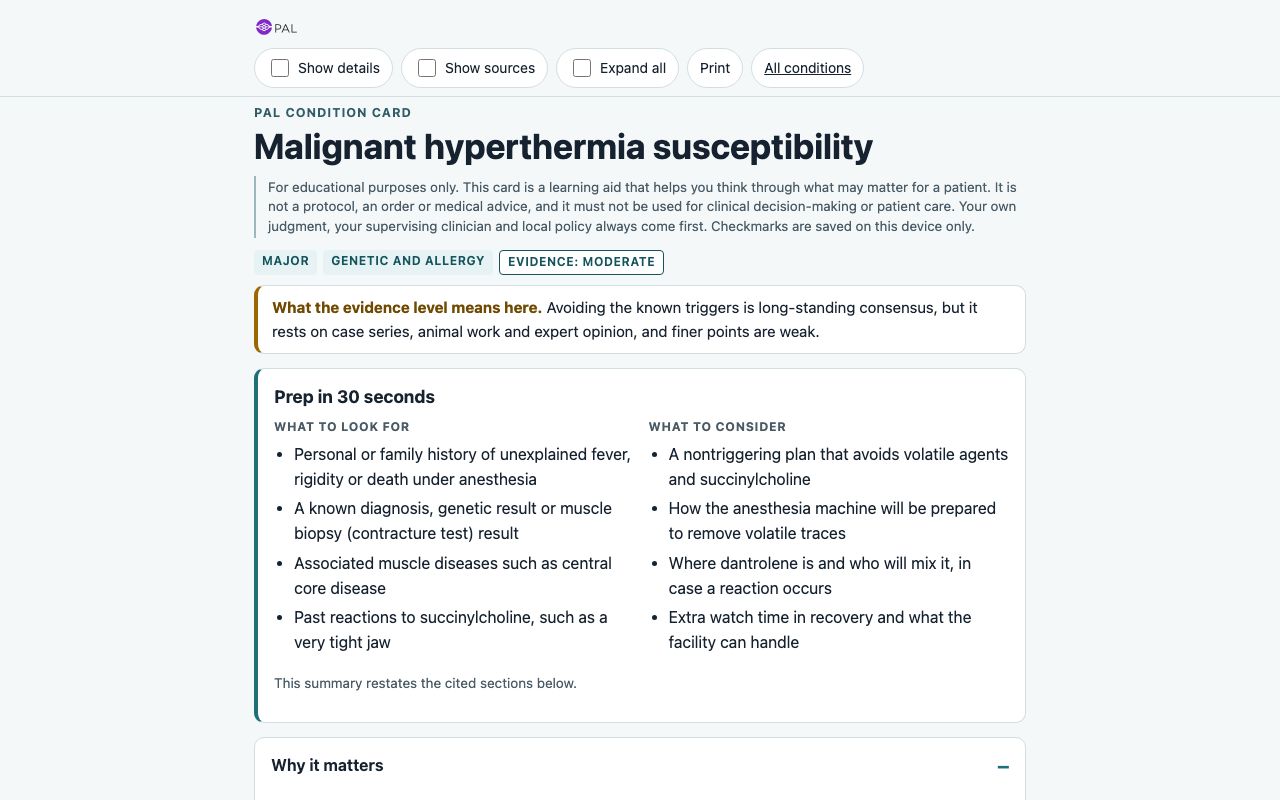
- Condition cards. A condition card covers one variable in a patient’s history and how that factor affects your anesthetic plan.
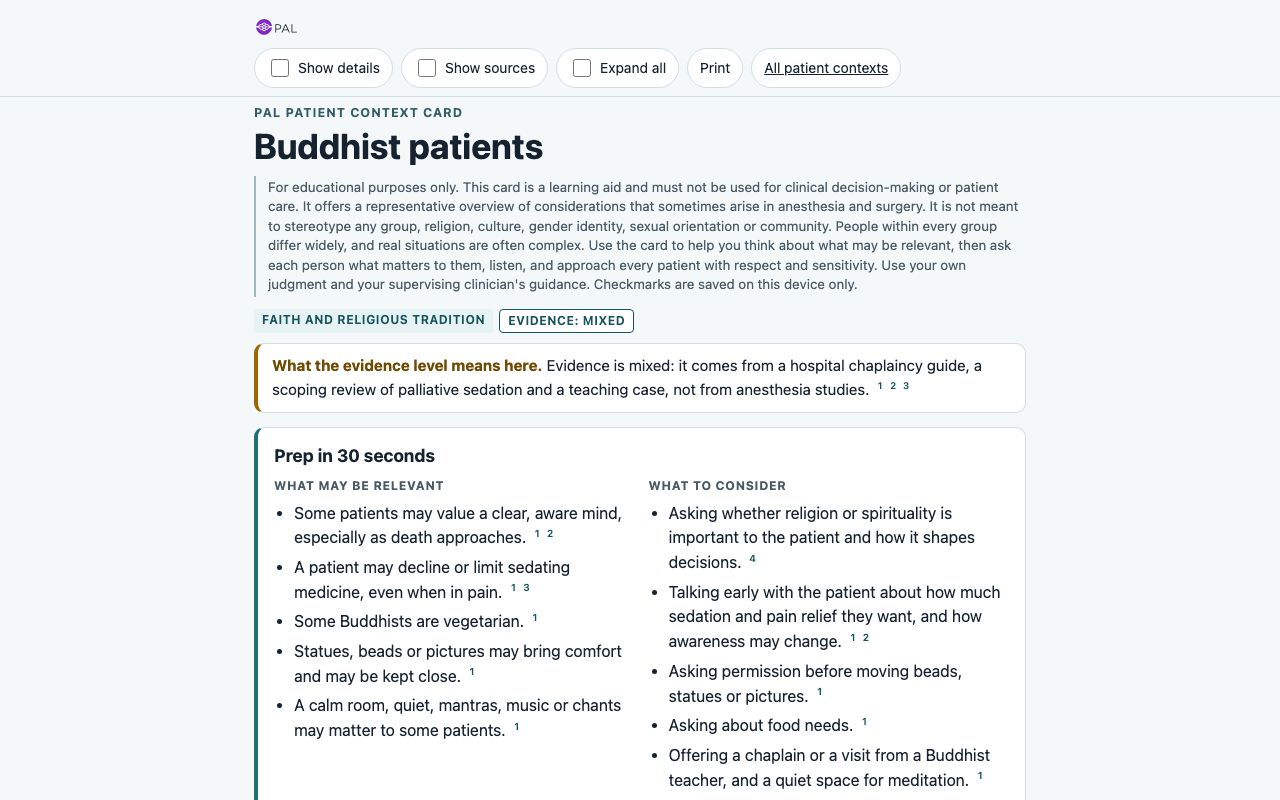
- Patient context cards. These cover a patient’s values, beliefs and circumstances, and how they affect your anesthetic plan.
PAL contents
135 Foundational Modules
- How general anesthetics act
- Capnography
- Anaphylaxis
- Arterial line
- Neuraxial block physiology
- Cardiac cycle
- Breathing mechanics
- Clotting cascade
- Autoregulation
- and many more
128 Learning Simulations
- Succinylcholine
- Local anesthetics
- Nitrous oxide
- Neuraxial anesthesia
- Anesthetic circuits
- One-lung ventilation
- Minimum alveolar concentration
- Compartment models
- Epidural test dose
- and many more
8 G.A.S. simulators
- Simple
- Advanced
- Induction and Airway
- Crisis
- Emergence
- TIVA and Low-flow
- Find the Problem
- Machine Checkout
7 Practice drills
- Difficult airway
- Arterial pressure monitoring
- Machine checkout
- Fire safety
- Pacing
- Infusion pump programming
- Syringe dosing
81 OR Day patient charts
- Tonsillectomy and adenoidectomy
- Laparoscopic cholecystectomy
- Left total knee arthroplasty
- Laparoscopic sleeve gastrectomy
- R carotid endarterectomy
- Living-donor kidney transplant (recipient)
- CABG x3 + AVR (bioprosthetic)
- Repeat cesarean, possible BTL
- Labor epidural analgesia
- and many more
90 Case cards
- Trauma laparotomy and splenectomy
- Awake craniotomy
- Carotid endarterectomy
- Total hip arthroplasty
- Laparoscopic cholecystectomy
- Below-knee amputation
- Total knee arthroplasty
- Robotic inguinal hernia repair
- Laparoscopic sigmoid colectomy
- and many more
164 Condition cards
- Malignant hyperthermia susceptibility
- Full stomach or aspiration risk
- Myasthenia gravis
- Pheochromocytoma
- Pulmonary hypertension
- Sickle cell disease
- Long QT syndrome
- Heart failure
- Asthma
- and many more
135 Medication cards
- Beta blockers
- ACE inhibitors and ARBs
- SGLT2 inhibitors
- Direct oral anticoagulants
- Warfarin
- Insulin
- Statins
- Metformin
- Aspirin
- and many more
37 Patient context cards
- Jehovah's Witness patients
- Advance directives and do-not-resuscitate orders in surgery
- Christian Science and faith-healing traditions
- Informed refusal and capacity
- Minors, parents and confidentiality
- Family and shared decision-making
- End of life and palliative surgery
- Organ donation and beliefs about the body
- Buddhist patients
- and many more